Commander Brackets Explained — The Official MTG & EDH 5-Bracket System
Status as of October 2, 2026: Wizards still labels the Commander Brackets “beta.” The last change to the bracket rules or the Game Changers list was February 9, 2026 (53 cards). The March 23, May 18, June 29 and August 10, 2026 Banned & Restricted announcements made no Commander changes. The next announcement is October 12, 2026; this page and our calculator are re-checked the day it lands.
Commander brackets are Wizards of the Coast's official power level system for the Commander format, introduced in February 2025. The 5-bracket system helps players find games at similar power levels by categorizing decks from ultra-casual (Bracket 1) to fully competitive cEDH (Bracket 5). Brackets are still in beta. In February 2026, WotC said it wants to “cool it on bracket-level changes for the time being.”
Quick Bracket Self-Check (no decklist needed)
Five quick questions place your deck in the right bracket. The questions check Game Changer count first, then mass land denial, two-card combos, and turn-to-win. That order is our own shortcut; WotC does not publish a decision tree. For a precise breakdown of any decklist, run the Bracket Calculator above.
Bracket self-check quiz
-
How many Game Changers does your deck contain?
See the 53-card Game Changers list to count.
-
Does your deck include mass land denial?
Wizards' definition is wider than "destroys lands": cards that regularly destroy, exile, bounce, keep tapped, or change the mana produced by four or more lands per player, without replacing them. Wizards’ own examples are Armageddon, Ruination, Sunder, Winter Orb and Blood Moon — note that the last two destroy nothing at all.
-
Does your deck have an infinite or game-ending combo?
Count combos of any size: Thassa's Oracle + Demonic Consultation, Heliod + Walking Ballista, or a three-card loop such as Ghave + Mazirek + Ashnod's Altar. Wizards keeps early two-card infinite combos out of Bracket 3.
-
Does your deck consistently threaten a win by turn 4 or earlier?
Cheap fast mana (Mana Vault, Chrome Mox), efficient tutors, and a compact win condition that goes off in the early game.
-
Is the deck built around a theme or creative goal rather than winning?
Tribal flavor, single-artist art, "oops, all commons", or a story-driven build. Choose Yes only if the deck is genuinely theme-first.
The 5 Brackets at a Glance
| Bracket | Name | Game Changers | Mass land denial | Extra turns | Two-card combos | Games last at least | Philosophy |
|---|---|---|---|---|---|---|---|
| 1 | Exhibition | None* | None | None* | None* | 9 turns | Ultra-casual. Prioritizes a goal, theme, or idea over power. |
| 2 | Core | None | None | No chaining | None | 8 turns | Mechanically focused decks with cards chosen for creativity or entertainment. |
| 3 | Upgraded | Up to 3 | None | No chaining | None before turn 6 | 6 turns | Powered-up decks with strong synergy and high card quality. |
| 4 | Optimized | No limit | Allowed | Allowed | Allowed | 4 turns | Lethal, consistent, and fast decks with no card restrictions. |
| 5 | cEDH | No limit | Allowed | Allowed | Allowed | Any turn | Competitively metagamed decks built to win as efficiently as possible. |
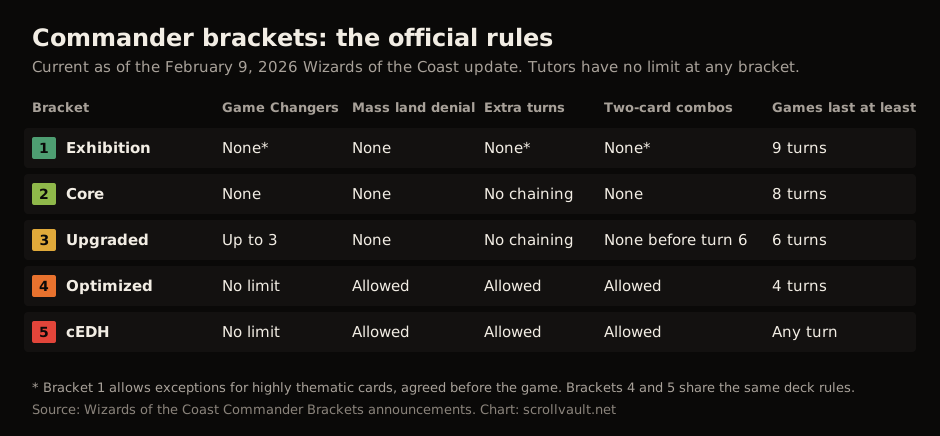
*Bracket 1 allows exceptions for highly thematic cards, agreed before the game. These are the rules from Wizards' October 2025 update; the February 9, 2026 update changed only the Game Changers list. There is no tutor limit at any bracket.
What our data shows. Our bracket calculator is tested against 1,229 tournament decklists whose brackets were set by the organizers who ran those events: 77.1% exact and 99.5% within one bracket on engine v389, against 73.9% exact for always answering Bracket 3. Of 178 distinct Commander precon decklists, 146 score Bracket 2, 31 score Bracket 3 and one scores Bracket 4; none is Bracket 1. And of 96 resolved bracket disputes, two thirds came from players who thought we rated their deck too low — the details are below.
Bracket 1 — Exhibition
Ultra-casual decks that prioritize a theme, idea, or creative goal over winning. Games typically last 9 or more turns. No Game Changers, no mass land denial, no extra turns and no two-card combos — though Wizards allows exceptions for highly thematic cards, agreed in the pregame conversation. Bracket 1 is the only bracket that rules out extra turns altogether; Brackets 2 and 3 only rule out chaining them. Exhibition is for players who want to express creativity through deck building — tribal themes, alternate win conditions, or flavor-first builds.
What Bracket 1 looks like in practice: Chair tribal. Squirrel tribal where every card has a squirrel in the art. "Oops, all commons" decks. A deck built around a specific story moment from the Magic lore. The goal is not to win — it is to create a memorable experience.
What pushes you OUT of Bracket 1: By the official rules, a Game Changer, mass land denial, an extra-turn card or a two-card combo that is not there for the theme, or a deck that regularly wins before turn 9. Wizards sets no limit on tutors or fast mana at any bracket, but a pile of them works against the "theme over power" intent, and players will notice.
Bracket 2 — Core
Straightforward, unoptimized decks where cards are chosen to maximize creativity rather than power. Games typically last 8 or more turns. No Game Changers are allowed. Most Commander preconstructed decks land in Bracket 2 — we measured 146 of the 178 distinct decklists (168 of the current 202 products, counting each Collector’s Edition and anthology reprint on its own) — though Wizards removed the precon anchor from this bracket in October 2025, so it is a result rather than a definition. This is the default casual Commander experience — social games where everyone gets to play their deck.
What Bracket 2 looks like: Upgraded precons. Theme decks with some optimization. Decks where you picked your 30 favorite cards for your strategy and filled the rest with staples. You might run Sol Ring and Swords to Plowshares, but you are not running Demonic Tutor or Rhystic Study. In our calculator data (as of September 28, 2026) it is the second most common result: 30,201 of 95,181 scored decks (31.7%), behind Bracket 3.
Key constraint: Zero Game Changers. If you add even one Rhystic Study, Cyclonic Rift, or Demonic Tutor, your deck moves to Bracket 3. This is the single most important rule for Bracket 2 deckbuilding.
Combos: Wizards’ deck-building list rules out intentional two-card infinite combos at Brackets 1 and 2. Wizards has also said “there are no infinite combos at Bracket 2” and that there are “no game-ending combos at the lower brackets.” Our calculator applies those statements to combos of any size, so a complete three- or four-card infinite combo also puts a deck at Bracket 3. Some tools count only two-card combos, so their results can differ.
Bracket 3 — Upgraded
Powered-up decks with strong synergy and high card quality. Games typically last 6 or more turns. Up to 3 Game Changers are allowed. Bracket 3 is where decks start to feel purposeful — you will see efficient interaction, strong card draw engines, and some combo potential. Mass land denial is still not appropriate here — and that includes lock pieces like Winter Orb and Blood Moon, not just sweepers like Armageddon or Ruination. Early-game infinite combos push a deck toward Bracket 4.
What Bracket 3 looks like: Precons that have been seriously upgraded with 20+ card swaps. Decks with a clear synergy engine and a defined win condition. You might include Rhystic Study for card draw, Demonic Tutor to find your finisher, and Cyclonic Rift as your emergency button — that is exactly 3 Game Changers, which is the maximum for Bracket 3.
The Bracket 3 sweet spot: Bracket 3 is the most common result in our calculator data (as of September 28, 2026): 46,080 of 95,181 scored decks (48.4%). It is powerful enough to feel rewarding but casual enough that games stay interactive and social.
Bracket 4 — Optimized
Lethal, consistent, and fast decks with no card restrictions beyond the banned list. Games typically last 4 or more turns. Unlimited Game Changers. Bracket 4 decks are built to win efficiently — they run fast mana, powerful tutors, and game-ending combos. Mass land denial, stax pieces, and two-card infinite combos are all fair game.
What Bracket 4 looks like: Decks that have been tuned for maximum efficiency within a specific strategy. Korvold sacrifice with Dockside loops (pre-ban). Najeela with a full mana base including Gaea's Cradle. Urza stax with Winter Orb and Static Orb. These decks have clear win conditions, efficient interaction, and the card quality to execute their plan consistently by turn 5–7.
The line between 4 and 5: Bracket 4 decks are optimized but not competitively metagamed. The difference between 4 and 5 is intent: Bracket 4 plays the best version of a fun strategy. Bracket 5 plays the best version of the best strategy, period.
Bracket 5 — cEDH
Competitively metagamed decks built for tournament-level play. Games can end on any turn. No card restrictions beyond the banned list. Bracket 5 is the ceiling — these decks combine fast mana, free counterspells, compact combo packages, and the most efficient tutors to win as quickly as possible. Every card earns its slot through competitive testing.
What cEDH looks like: Thrasios + Tymna consultation decks. Turbo Ad Nauseam. Rogsi (Rograkh + Silas Renn). Najeela tempo. These decks share common traits: Mana Vault, Chrome Mox, free counterspells (Force of Will, Fierce Guardianship, Pact of Negation), compact win conditions (Thassa's Oracle + Demonic Consultation), and ruthless efficiency. Every card either advances the game plan, disrupts opponents, or generates mana.
Is cEDH fun? Absolutely — but it is a completely different game from casual Commander. The best cEDH games feel like a tense multiplayer chess match where every decision matters; the worst end on turn two with no interaction. The format is at its best when all four players are prepared and the table is balanced.
What Are Game Changers?
Game Changers are a curated list of 53 powerful cards maintained by WotC. WotC describes them as cards that “can dramatically warp Commander games.” They are not banned — they are legal to play — but they count toward bracket restrictions:
- Brackets 1-2: Game Changers are not allowed
- Bracket 3: Up to 3 Game Changers per deck
- Brackets 4-5: No limit
Game Changers include cards like Rhystic Study, Cyclonic Rift, Demonic Tutor, and The One Ring. See the full list on our Complete Game Changers List page.
Important: Game Changers are NOT the same as banned cards. Banned cards (like Dockside Extortionist, Mana Crypt, and Nadu) are completely illegal in Commander. Game Changers are legal but restricted by bracket.
What Forces Each Bracket?
| Factor | Minimum Bracket |
|---|---|
| Any Game Changers (1+) | Bracket 3 floor |
| 4+ Game Changers | Bracket 4 floor — exceeds Bracket 3’s limit of three Game Changers (often still plays like Bracket 3) |
| Mass land denial | Bracket 4 |
| Any two-card combo (game-ender, lockout or infinite) | Bracket 3 — and only if it cannot come together before turn 6 |
| Two-card combo that can win before turn 6 | Bracket 4 |
| Infinite or game-ending combo of three or more cards | Bracket 3 — our reading of Wizards’ “no infinite combos at Bracket 2” |
| Extra-turn cards | Bracket 2 (Bracket 1 allows them only for a highly thematic deck) |
| Chaining extra turns | Bracket 4 |
| Tutors, fast mana | No official limit at any bracket (removed October 2025) |
How to Determine Your Bracket
Follow these steps to figure out where your deck falls in the bracket system:
- Count your Game Changers — check the official list and count how many your deck contains. Zero keeps you in Brackets 1-2. One to three puts you in Bracket 3. Bracket 3 allows up to three; a fourth Game Changer exceeds that limit and sets a Bracket 4 floor by the deckbuilding rules — though without early combos, mass land denial, or consistent fast wins such a deck often still plays at Bracket 3 power.
- Check for mass land denial — this is wider than land destruction. Armageddon, Ruination and Sunder qualify, but so do Winter Orb and Blood Moon, which deny lands without destroying any. All five are Wizards’ own examples. Wizards' test is whether the card affects four or more lands per player without replacing them. Any of these push your deck to Bracket 4.
- Look for two-card infinite combos — compact combos that win the game on the spot (such as Thassa's Oracle + Demonic Consultation) are a Bracket 4 signal.
- Evaluate your fast mana, tutors, and overall card quality — this is judgment, not a rule. Wizards removed tutor limits in October 2025 and relies on the Game Changers list to catch the most efficient ones, but a high density of tutors, free counterspells and fast mana still makes a deck play faster, and speed is what separates Bracket 3 from Bracket 4.
- Consider your deck's expected turn count to win — if your deck consistently threatens a win before turn 6, it is likely Bracket 4 or higher.
Use our Commander Bracket Calculator to automatically analyze your decklist and get a bracket rating with detailed breakdown.
Common Bracket Disputes
The bracket system is not perfect, and some situations create legitimate disagreements. Common disagreements, and how the rules answer them:
- "My precon has Game Changers from the factory." Some older precons include cards that are now on the Game Changers list. Technically, those precons are Bracket 3, not Bracket 2. If you want to play at Bracket 2, swap those cards out for non-Game-Changer alternatives.
- "My deck has a combo but I never tutor for it." WotC's rules talk about intentional combos, but if both pieces are in the deck, most tables will assume you mean to use them. If your deck contains Thassa's Oracle and Demonic Consultation, it has a two-card instant-win combo regardless of whether you search for it. That is Bracket 4.
- "Sol Ring is more powerful than most Game Changers." Fair argument. WotC kept Sol Ring off the list because it is in every deck already — restricting it would effectively eliminate Brackets 1 and 2. The Game Changers list targets cards that are powerful AND selective, not cards that are universally played.
- "Bracket 3 with three Game Changers is stronger than some Bracket 4 decks." True. Brackets are guidelines, not exact measurements. A Bracket 3 deck with Rhystic Study, Cyclonic Rift, and Demonic Tutor can absolutely outperform a Bracket 4 deck that runs mass land denial but no tutors. Use brackets as a starting point for conversation, not a final answer.
What 96 Resolved Disputes Tell Us
Every verdict our calculator returns can be challenged. As of October 1, 2026, players have filed 145 challenges against our bracket calls and we have resolved 96 of them. That record is worth publishing, because it is the only public measurement we know of showing where the bracket system actually causes arguments.
Two thirds of the time, players think we rated them too low.
| Challenge | Share of resolved cases |
|---|---|
| Player argued the deck belongs in a higher bracket | 66% |
| Player argued the deck belongs in a lower bracket | 29% |
| Other or unspecified | 5% |
The arguments cluster on one seam. Of the 91 cases where a player named a different bracket than we did, 42 were Bracket 3 against Bracket 4 and 33 were Bracket 2 against Bracket 3. Everything else combined accounts for 16. The Bracket 3/4 line is where the official rules change from a countable limit to no limit at all, and it is where real decks refuse to sort cleanly.
We also lose these arguments regularly. Of the 96 resolved challenges, 34 were granted and 5 produced an adjustment — we changed our own call in 39 cases, about 40%. The remaining 57 were denied with a written reason. We publish that number rather than hide it, because a bracket tool that is never wrong is a bracket tool that is not being checked.
Where the Official Rules Stop
Most disagreements are not mistakes. They happen because the official system deliberately leaves room, and Wizards says so in its own words. The bracket system is still, as of today, labeled a work in progress on the official format page:
Commander Brackets are currently in beta. As you try them, we welcome your feedback over on our Discord!
Four gaps produce most of the arguments we see:
- Combos are judged on intent, which nothing can verify. Wizards: "There's something to be said for intent, which is why we call out no intentional combos and the intent to chain together extra-turn spells." A decklist cannot show intent. Two identical lists can sit in different brackets depending on what their pilots meant, and no tool, ours included, can read that.
- Tutors are no longer in the rules at all. The original system asked for tutors to be "sparse" in Brackets 1 and 2 without defining the word. In October 2025 Wizards dropped the requirement entirely: "remove the tutor restrictions from Commander Brackets entirely and rely on Game Changers to catch the most efficient tutors." So a Bracket 2 deck can legally run eight tutors that are not Game Changers, and whether that still feels like Core is left to the pregame conversation.
- The three-Game-Changer limit is a judgment call, openly. Asked why three, Wizards answered: "We talked a lot about decks we had, what we expected, and what felt about right so that your deck could have some of these cards show up but not be full of them." That is a reasonable way to set a starting point. It is not a measurement, and it explains why the Bracket 3/4 seam generates the most disputes.
- Mana bases are outside the system entirely. Wizards: "While mana is of course critical for playing Magic, it's rare that a mana base is what causes games to be unfun or warping for other players, which is what the focus is on here." So two decks with identical spells and wildly different mana can carry the same bracket.
There is a fifth gap worth stating plainly, because it is the one no calculator can close. Brackets 4 and 5 have identical deck-building rules — both read "There are no restrictions (other than the banned list)." The difference between them is described as a mindset: metagame focus, tournament intent, and table behavior. A decklist cannot contain a mindset. Any tool that claims to sort Bracket 4 from Bracket 5 on cards alone is overreaching, and we say so on our own verdicts.
Wizards also endorses imprecision directly: "There's some wiggle room, and while playing against decks that are all inside your bracket is ideal, you can usually wiggle within one bracket away from you safely." That is why we report how close a deck sits to its boundary rather than only a number.
What Actually Predicts a Bracket
The official guidance pairs each bracket with a rough game length — nine or more turns at Bracket 1, four or more at Bracket 4. It is a useful way to describe the feel of a game. We tested whether it works as a measurement, and on our data it does not.
We ran our goldfish simulator across 242 decks from our corpus at 600 iterations each and correlated the resulting speed estimate against deck properties. The result was not what the framing implies:
| Deck property | Correlation with simulated speed |
|---|---|
| Land count | −0.613 |
| Creature count | −0.432 |
| Average mana value | −0.127 |
| Ramp, rocks and rituals | −0.057 |
A speed clock that tracks land count at −0.613 and acceleration at −0.057 is largely counting lands. It also has very little resolution: across those 242 decks it produced only nine distinct values. And when we improved the simulator so it understood 3.3 more cards per deck, the median it reported moved by zero.
Contents predict far better than pace. Measured against 91 decks whose brackets were adjudicated by people rather than software, the speed estimate carried essentially no signal, while Game Changer count scored 0.522 and complete two-card combos scored 0.303.
This is why our engine weighs what a deck contains ahead of how fast it goldfishes, and treats speed only as a supporting signal. We are publishing the measurement rather than the conclusion alone, so anyone can check it.
A note on scope: this is a correlation study over our own corpus, not a controlled experiment, and the simulator models a deck drawing on an empty board rather than a real four-player game. It is evidence that the speed clock is a poor instrument for sorting brackets. It is not evidence about how long your games actually last.
Practical Tips for Using Brackets
- Talk before you play. Brackets work best when all four players discuss their decks before shuffling. State your bracket AND give a one-sentence description: "Bracket 3, Meren sacrifice with Rhystic Study as my only Game Changer."
- Use the calculator for objectivity. When players disagree about a deck's bracket, an automated tool gives everyone the same starting point, though WotC stresses that “any estimate is just an estimate.” Our Bracket Calculator analyzes Game Changers, combo density, tutor count, mana curve speed, and 14 synergy axes to produce a bracket rating.
- Bracket up when in doubt. If you are unsure whether your deck is Bracket 2 or 3, call it Bracket 3. It is better to slightly overstate your power than to pubstomp a casual table. Players forgive underpowered opponents faster than overpowered ones.
- Have multiple decks at different brackets. The best way to enjoy Commander is to have at least two decks at different power levels. Bringing a Bracket 2 and a Bracket 3 deck to game night lets you match whatever the table wants to play.
Bracket Update History
| Date | Changes | GC Total |
|---|---|---|
| February 11, 2025 | Brackets Beta introduced with 40 initial Game Changers. | 40 |
| April 22, 2025 | 18 cards added. 5 unbanned cards added (Braids Cabal Minion, Coalition Victory, Gifts Ungiven, Panoptic Mirror, Sway of the Stars). Trouble in Pairs and Trinisphere removed. | 61 |
| October 21, 2025 | 10 cards removed: high-CMC legends (Expropriate, Jin-Gitaxias, Vorinclex, Sway of the Stars), command-zone-strongest legends (Kinnan, Urza, Winota, Yuriko), plus Deflecting Swat and Food Chain. | 51 |
| February 9, 2026 | Farewell added. Biorhythm unbanned and added the same day. | 53 |
| March 23, 2026 | Banned & Restricted announcement — no Commander or bracket changes. Game Changers list unchanged. | 53 |
| May 18, 2026 | Banned & Restricted announcement — no Commander or bracket changes. Game Changers list unchanged. | 53 |
| June 29, 2026 | Banned & Restricted announcement — no Commander or bracket changes. Game Changers list unchanged. | 53 |
| August 10, 2026 | Banned & Restricted announcement — no Commander or bracket changes. Game Changers list unchanged. | 53 |
Each date links to the official WotC announcement. Last verified October 1, 2026.
Sources
- Bracket framework: Wizards of the Coast: Introducing Commander Brackets Beta (Feb 11, 2025) — original announcement defining Bracket 1 (Exhibition), 2 (Core), 3 (Upgraded), 4 (Optimized), and 5 (cEDH).
- Format reference: MTG Commander Format — canonical format home page (Game Changers, banned list, bracket rules).
- Game Changers list: Scryfall
is:gamechanger— 53 cards. Last list change: February 9, 2026. Verified unchanged through the August 10, 2026 B&R announcement. - Banned card distinction: Commander Banned and Restricted Announcement (Sept 23, 2024) — the announcement that banned Dockside Extortionist, Mana Crypt, Jeweled Lotus, and Nadu, Winged Wisdom.
Brackets vs. the Old "1–10 Scale"
Before the official bracket system, most Commander playgroups used an informal 1–10 power level scale. The problem was that everyone's scale was different. One player's "7" was another player's "4." Four players could all call their decks a 7 and bring anything from an upgraded precon to a near-cEDH list.
Brackets solve this by defining concrete criteria. A Bracket 2 deck has zero Game Changers and no infinite combos — that is verifiable. A Bracket 3 deck has 1–3 Game Changers — you can count them. There is still room for interpretation (some Bracket 3 decks are stronger than others), but the system is far more reliable than a subjective number.
My recommendation: use brackets as your primary communication tool, then add context. "Bracket 3 — Meren sacrifice, pretty focused but no fast mana" gives your table everything they need to know. If someone at your table still uses the 1–10 scale, here is a rough mapping, using the same bands as our calculator’s power score:
- 1–2 on the old scale ≈ Bracket 1 — Theme decks, jank, extremely casual
- 3–4 ≈ Bracket 2 — Straightforward, unoptimized
- 5–6 ≈ Bracket 3 — Upgraded, focused, some powerful cards
- 7–8 ≈ Bracket 4 — Optimized, fast combos, efficient interaction
- 9–10 ≈ Bracket 5 — cEDH, tournament level
Related Resources
- Commander Bracket Calculator — paste your decklist for instant bracket analysis
- Complete Game Changers List — all 53 cards organized by color with bracket rules
- How to Build a Commander Deck — deck building fundamentals with the 10-10-10 framework
- MTG Manabase Guide — Frank Karsten's mana math for Commander and every other format
- Commander Salt Scores — what the community finds annoying, and why it is not what the brackets measure
Frequently Asked Questions
Work top-down: (1) count Game Changers from the official list — zero is Bracket 1–2, one to three is Bracket 3, four or more exceeds Bracket 3’s limit and sets a Bracket 4 floor by the rules (though it often still plays at Bracket 3 power); (2) any mass land denial or fast two-card infinite combo makes it Bracket 4; (3) any other infinite or game-ending combo, whatever its size, makes it at least Bracket 3 by our reading of Wizards’ statements; (4) otherwise weigh fast mana, tutors, and how early it can win. For an instant, validated answer, paste your decklist into our Commander Bracket Calculator — it weighs all of these signals and is tested against 1,229 tournament decklists whose brackets were set by the organizers who ran those events: 77.1% exact and 99.5% within one bracket on engine v389, against 73.9% exact for always answering Bracket 3. Full workings are in our validation methodology.
There are 5 official Commander brackets: Bracket 1 (Exhibition), Bracket 2 (Core), Bracket 3 (Upgraded), Bracket 4 (Optimized), and Bracket 5 (cEDH). The system was introduced by Wizards of the Coast in February 2025 and is currently in beta.
No. Game Changers are not allowed in Brackets 1 or 2. If your deck contains even one Game Changer (such as Rhystic Study, Cyclonic Rift, or Demonic Tutor), your deck is at minimum Bracket 3. Bracket 3 allows up to 3 Game Changers. Brackets 4 and 5 have no Game Changer limit.
There is no fixed schedule. Wizards has changed the list in February 2025 (the initial 40 cards), April 2025, October 2025 and February 2026. The February 2026 update said the next check-in would likely come in May or June 2026; as of October 1, 2026 none has been published, so the list still stands at 53 cards.